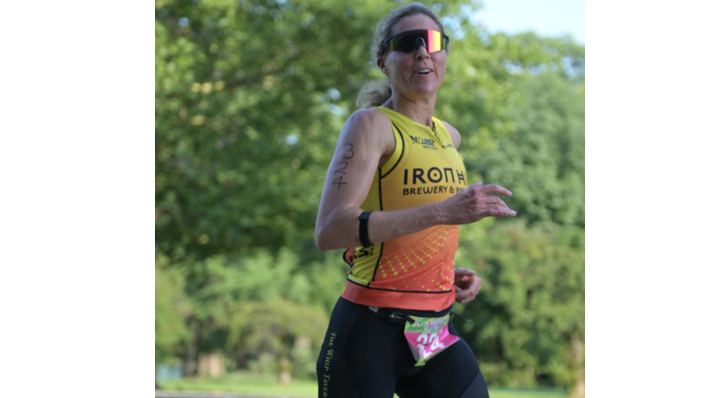

This past weekend, I had the privilege of winning the DelMoSports, LLC Philly Women's Duathlon. (I know, 🙄. Not a typo - it's race season!!!).
It was anything but comfortable. 🥵
For most of the race, the woman in second place was closer to me than my own shadow. I heard her breath and her footsteps. She got out of transition faster than me. Twice. The only reason I held the lead is because I had an incredible bike leg, and I ran my way back into the lead when she passed me on the first run.
Ironically, that's exactly why I love this race. Not because of the result. Because of the people.
Every year, I leave inspired by the woman athletes around me.
One woman I met in line for the port-o-johns beat breast cancer just two years ago. Another competitor that I look for year after year donated a kidney to her mother last year. She still raced. And WON her age group.
I also caught up with an athlete I've crossed paths with at multiple races over the years. One of the unexpected gifts of endurance sports is realizing how many people are quietly doing extraordinary things - and choosing not to make a big deal of it.
Some athletes paid extra for VIP bike racking so they could start with their bikes closer to the bike exit.
I've never done it. Not once. Some people think buying a better rack position creates an advantage. I don't.
Transition is a rectangle. I figure that every athlete has to cover about the same total distance. (If you are closest to the bike out, then you are likely far from the bike in. If you are close to the run out, then you are likely far from the bike out.) You can't shortcut the geometry.
Get into transition first. Everything else takes care of itself.
Organizations often look for shortcuts. Better software. More dashboards. Another incentive. A new AI tool. Those things can help. But exceptional performance isn't purchased with a better rack position.
They prepare better. They execute consistently. They make decisions under pressure. They recover quickly when things don't go perfectly (like a transition where you drop your helmet and have to pick it up).
They bet on themselves.
That's exactly what we find when we study Positive Deviants. They rarely possess dramatically different resources. They simply use the resources they have differently.
Winning wasn't today's biggest lesson - it never is. The biggest lesson was being surrounded by people who quietly demonstrate what extraordinary looks like.
Those are the people worth studying. Those are the people worth becoming.
I also noticed something else. The athletes who challenged me weren't obstacles. They were gifts. As I've shared before, had they not been there pushing me, I wouldn't have run as fast on that second run leg.
High performers often talk about competition as something to beat. Positive Deviants understand something different: great competitors reveal your best self.
That's another reason I keep coming back to races like this. They remind me that excellence is rarely created in isolation. It's created in the presence of people who are also choosing to be extraordinary.
(Feeling blessed because I have someone that will wait for hours to see me for seconds).