
In a recent MasterClass session, Richard Branson said something simple - and when I heard it, I realized he just described Exemplary Performance. He said:
“Most of the best businesses come out of frustration.”
He described walking into the airline industry and seeing:
Terrible in-flight entertainment. Inedible food. Cumbersome ticketing and seating policies. Indifferent service.
Instead of accepting it, he made two lists:
“This frustrates me.” “Why not?”
And then he "stayed on his feet." He talked to crew. He talked to flight decks. He talked to customers. He carried a notebook. He took the feedback and suggestions and implemented what worked.
That’s how Virgin Atlantic was born.
Our Frustration (The One No One Says Out Loud)
In complex B2B sales, customer service, or really any of our client industries, here’s what frustrates our customers:
You have a few bright spots. You have many capable but inconsistent performers. Revenue growth lags strategy. Sales training is expensive. Enablement is busy. Performance doesn’t sustainably change.
You’ve invested in:
AI Workshops Playbooks Sales Methodologies and Frameworks Certifications Coaching models CRM tools
Yet the distribution curve barely moves. So, we asked our own version of Branson’s questions.
“This frustrates me.”
Training treats everyone the same and doesn't impact performance. Enablement builds content before diagnosing excellence. Managers are expected to coach without a blueprint. Top performers are rewarded… but not studied.
“Why not?”
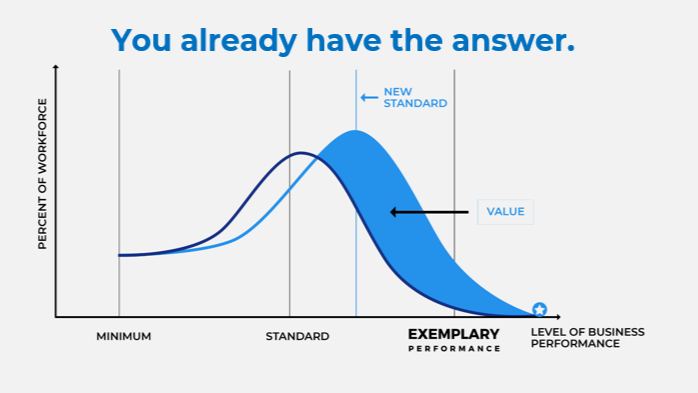
Why not reverse-engineer the top 1%? Why not codify what they do differently? Why not make excellence transferable? Why not build systems around what already works?
Stay on Your Feet
Branson didn’t redesign airlines from a boardroom. He talked to the people doing the work.
That’s Positive Deviance.
At Exemplary Performance, we do the same: We don’t start with curriculum. We start with your best people.
We conduct behavioral interviews. We decode their thinking. We isolate their choices under pressure. We extract what they PRODUCE that others don’t.
And then we ask:
What do they do before the call that others skip? Who do they lean on to help produce value? How do they frame value differently? What do they listen for? How do they recover from resistance? How do they orchestrate stakeholders? How do they manage internal complexity?
Recommended by LinkedIn The Business Case for Sales Coaching Jimmy Curtin "The Sales Coach", CEO, CIQ, CSP, CSC 6 years ago The Chemistry Conundrum Chris Ryan 10 months ago Coach more and ‘manage’ less Jenny Fahey 7 years ago
Your top 1% already solved the problem. The rest of the system just hasn’t caught up.
Training Is Usually the Wrong Starting Point
Branson didn’t say, “Let’s train the crew to smile more.”
He changed:
The experience. The environment. The expectations. The standards.
Training is only one lever.
Performance lives in:
Hiring profiles. Manager coaching capability. Incentives. Systems. Role clarity. Cultural norms that enforce the performance standard.
If those don’t align with what your best people actually do, no workshop will fix it.
The Exemplary Performance Advantage
Every organization has:
A few who consistently outperform. A few who struggle. A large middle.
The frustration isn’t lack of talent. It’s lack of transparency around excellence.
Once excellence is visible:
Hiring improves. Coaching becomes specific. Training becomes surgical. Managers know what “good” actually looks like. Enablement stops guessing.
Revenue follows.
If You’re Frustrated…
If you’re tired of:
Investing in enablement that doesn’t stick. Celebrating Presidents Club without understanding the “how.” Watching managers default to coaching activity over impact. Seeing strategy disconnected from field behavior.
You’re in the right frustration. And frustration is a fantastic starting point.
Branson built an airline because he refused to tolerate a broken experience.
We built Exemplary Performance because we refuse to tolerate guesswork in sales excellence.
If you had to make your own two lists today:
What frustrates you about your sales performance? And more importantly… Why not fix it by learning from your own best?