
At 4:30AM Sunday morning, I called my dad.
My race sherpa. The guy who has stood in the rain, the cold, the heat, and countless transition areas waiting for me to do something voluntarily uncomfortable.
"Good morning," I said. "Go back to bed."
"What? I was just tying my sneakers."
"Well, untie them. I'm not going."
Silence. Then: "WE'RE not going, or YOU'RE not going?"
It was a fair question. Years ago, I would have interpreted that as permission. Permission to sneak out alone. Permission to race anyway. Permission to spare him the misery of standing in a downpour for several hours while I splashed through puddles, socks sogging, pretending this was a good idea. (After all, we did this very thing last year when it rained for this event).
In fact, I did exactly that once. I made the decision for both of us. I thought I was doing him a favor. What I was really doing was taking away his choice. It hurt both of us. We go together now - always.
So, this time the answer was different. "No. I'm really not going."
I checked the radar one last time. The biggest, darkest storm cell was directly over the race. The weather was awful. The roads were too dangerous, I thought. The risk wasn't worth the reward. Somewhere in my journey, I found the hairpin trigger of a line between intensity and reckless obsession. That itself, is growth. Maturity. Restraint.
And honestly? I didn't need the race. The day before, I had learned I was currently ranked #1 nationally in season points.
I don't attach much meaning to rankings. They're temporary. They don't mean you are a better person, a better mom, or a more skilled employee. Someone always catches you, someone always passes you. But they are recognition of something about which I do care deeply:
Consistency. Showing up, like Dad says. Doing the work. Giving your best. Day after day. Week after week. Month after month. Season after season. Year after year.
The ranking wasn't evidence that I was the fastest - it was evidence that I kept showing up.
So, Sunday's race was canceled. Or at least that's what I told myself and my coach Holly Benner, ACC .
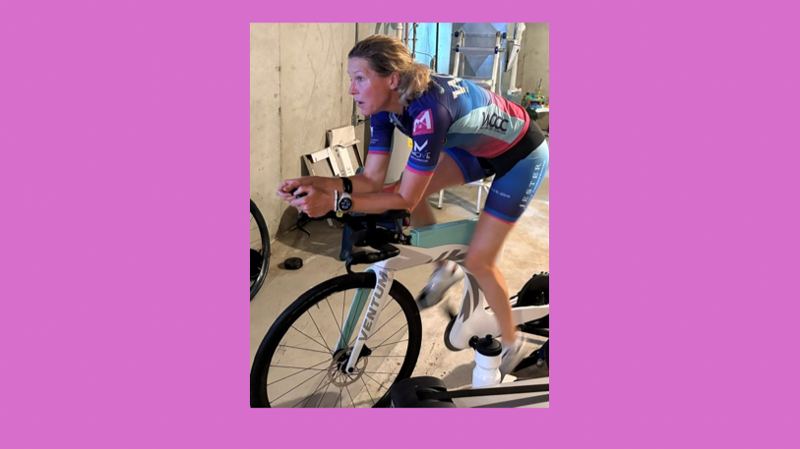
A few hours later, I stepped onto the treadmill in the corner of my basement.
I ran the race distance for the first leg. Then climbed onto the bike trainer and rode my a$$ off. Then I got back on the treadmill and ran again for the third and final leg.
When I compared times later, I finished roughly two minutes behind my friend Tim, who had actually raced that morning. Ironically, that was almost exactly where I finished last year.
Same effort. Different venue. No finish line. No crowds. No finisher medal. No podium. No race swag. No body marking. No results sheet. Just the work. (Work that starts the week leading up to the race with focused nutrition, hydration, sleep, packing gear, leaving race-day execution as the final 20%).
And that's when I remembered something from The Way of Excellence by Brad Stulberg .
I love to compete. Not win. Compete.
Those sound similar, but they're radically different.
People who love winning need conditions to be right. They need a scoreboard. An opponent. Validation. Recognition.
People who love competing don't need any of that. Take away the race and they'll find another race. Take away the audience and they'll still perform. Take away the trophy and they'll still show up.
Because the real competition is never external. It's internal.
Can I honor the commitment I made to myself?
Can I do the work when nobody is watching?
Can I maintain the standard even when the reward disappears?
That's a different game. And it's not limited to sports.
The highest-performing people we study at Exemplary Performance operate the same way.
The best sales leaders don't wait for quota pressure to become disciplined.
The best managers don't coach only when HR tells them to, or someone needs a PIP.
The best organizations don't pursue excellence only when a customer is watching.
They compete every day against a standard. A standard of preparation. A standard of execution. A standard of accountability. A standard of excellence.
When teams become dependent on recognition, incentives, rankings, or urgency to perform, performance becomes situational.
That's why identifying and operationalizing excellence matters.
The goal isn't to help people win once. The goal is to help them compete every day.
Because eventually every organization faces a version of Sunday's storm.
Budget cuts. Market shifts. Leadership changes. Missed targets. Unexpected obstacles.
The external race gets canceled. What happens next determines everything.
Do people stop? Or do they find a treadmill, a trainer, and another way forward?
The last race of the season - wasn't. Because for those who truly love to compete, the race was never the event. The race is the standard. Every single day.