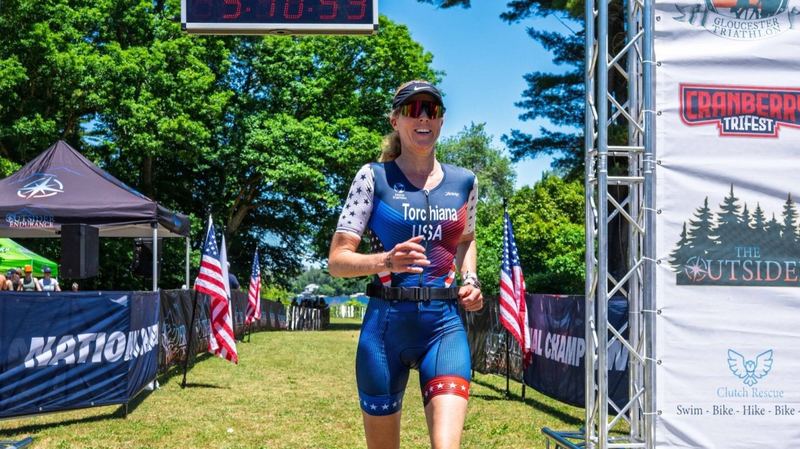

At the start line, something felt off.
Not the course. Not my legs. Not even the nerves. Well, maybe the nerves.
It was my sweat. It smelled differently.
Not to be gross...but it wasn't the clean, familiar smell of effort - the kind that shows up when your body is doing what it knows how to do. This was sharper. Pungent. RIPE. Uneven. Like something inside me hadn’t decided yet if it were ready.
Nervous sweat. Anxious sweat.
And standing there at the Outsider Endurance Patriot Half National Championships with a 3-mile run, 56-mile bike, and 13-mile run in front of me, I had a thought I hadn’t thought in a l-o-n-g while:
Did I choose the right level of hard… or did I overshoot?
Two and a half weeks earlier, I had signed up for the race.
That mattered more than it should have.
Because a few weeks before that, I had written about the grief of a goal I didn’t pursue -qualifying for both Duathlon Nationals AND Worlds and "choosing" to not go to either. Life was full: travel, birthdays, Mother's Day, commitments that mattered more. Or at least mattered equally and conflicted. I didn’t feel I could choose the races then.
But standing here, I had chosen this. Which made the question sharper.
The first run was easy.
Deceptively easy. My breathing was light, unlabored. I quickly found my rhythm.
It was the kind of ease that invites a mistake: go faster, prove something, get ahead early.
But long courses don't work that way. No one wins these in the first 5K.
So, I held back. Kinda. Less than I planned with my Coach, but I was feeling great.
Let people go.
Stayed inside myself. Regulated. Disciplined. Steady.
At that point, the question faded a little. Maybe this was fine. Maybe I hadn’t overshot after all.
Then came the bike.
I brought a road bike to a triathlon party. It's my only bike now, so I didn't have a choice. Fellow racer and friend, Karoline, said, "I was so glad to see you bring a knife to a gun fight. It inspired me that I could be competitive today."
Sleeker bikes passed me with a kind of ease that’s hard to ignore. You can hear and feel the difference -not just in speed, but in efficiency. Every pedal stroke I pushed seemed to ask for something back. And I didn't want to give it.
And then the wind picked up. Coach Holly Benner, ACC in our prep call a few days prior said, "It looks like it will be around 8mph, so you'll feel it. It's not nothing." It was something.
Around mile 24, it wasn’t subtle anymore.
My legs weren’t politely asking or negotiating - they were begging for relief. My glutes were screaming to get off the saddle that had somehow molded to me.
I remember thinking, very clearly: This is hard.
Not in a satisfying way. Not in a “this is what I trained for” way.
But in a I might have miscalculated this way.
And at the same time, I was still moving. Not fast. Not comfortably. But steadily.
I wasn’t collapsing. I wasn’t coasting. I was in it.
That’s where something shifted.
Because it’s easy to think that “too hard” means suffering.
But suffering alone doesn’t tell you anything.
Somewhere in that stretch, I realized:
The second run made that even clearer.
By mile two, it was nearly 90 degrees and I swear 90% humidity. I was dizzy. Literally.
My legs were still carrying the bike with them. I started breaking the race down: not 13.1 miles, but smaller pieces. Aid station to aid station. Four-mile chunks. Get to six, you’ll be okay.
Walk the aid stations. Take the Gatorade, water, and pour more water on your head. Stuff your sports bra with the ice. Repeat.
Keep moving. Don’t make it bigger than it is. Find the shade. Run the angles.
Again, the question wasn’t gone, but it had changed.
It wasn’t did I overshoot?
It was: can I stay inside this?
Because I still wasn’t at a place where I had to stop. Only a place where I wanted to.
At the 11th mile aid station, I knew I could do it.
Not in a triumphant, surprising way. In a quieter way. A relieving way.
Like something had resolved itself mid-race and just carried through. My pace quickened. I could see the finish.
The soreness afterward told the rest of the story. I probably showed up 80% trained. The other 20% came from race-day adrenaline, focus....and maybe stubbornness? And sweat equity.
All of it helped. But none of it changed what I had already learned.
The right place is harder to describe, but easier to recognize once you’ve felt it.
It’s not comfort. And it’s not collapse.
It’s the place where you want to stop… but don’t actually have to. That’s different.
That’s where something is being built: not proven, not survived.
Standing at that start line, I didn’t know if I had found that line.
On the bike, I thought I might have missed it.
By the second run, I knew I was on it.
Not because it felt good. Not because I was winning.
But because I hadn’t crossed into the place where the choice was taken away from me.
I was still choosing. Every mile.
And that’s the signal.
Not whether something feels hard.
But whether it’s the right kind of hard.